
Political parties in Israel have taken different positions on who should form the country’s next government, with three factions backing Prime Minister Benjamin Netanyahu while another has thrown its weight behind opposition figure Gadi Eisenkot.
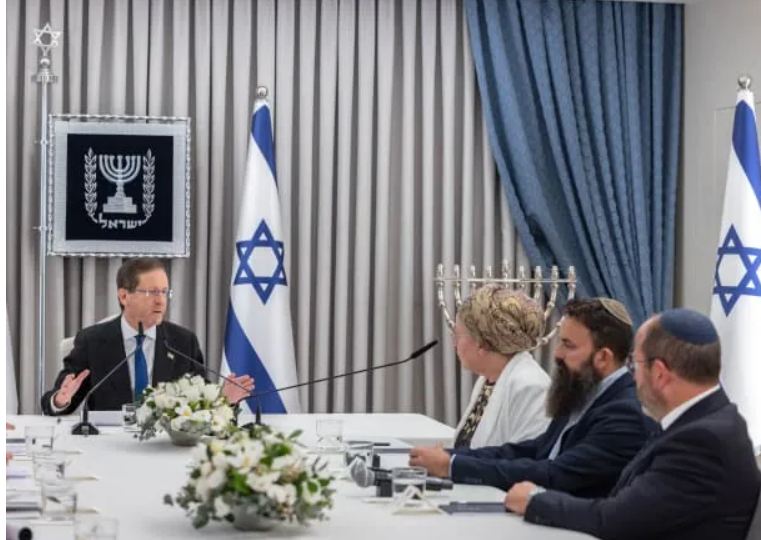
The consultations began at the President’s Residence in Jerusalem on Wednesday, November 4, 2026, as President Isaac Herzog met representatives of political parties following the elections to the 26th Knesset.
The Religious Zionist Party (RZP), Shas and Zehut recommended Netanyahu for the mandate to form the next government.
However, Yisrael Beytenu, led by Avigdor Liberman, nominated Eisenkot, chairman of the Yashar party, for the position.
Despite the initial recommendations, Eisenkot is expected to receive considerable support from other opposition parties during the consultations, which were scheduled to conclude on Thursday evening.
Under Israeli law, the president must consult political factions in the Knesset before deciding which candidate should receive the mandate to form a government.
Netanyahu secures backing from three factions
The first delegation to meet Herzog was from the Religious Zionist Party, led by Finance Minister Bezalel Smotrich.
The delegation included Settlement and National Missions Minister Orit Strock, Itamar Eitam and Zvika Mor.
Representatives of the ultra-Orthodox Sephardic Shas party followed.
The Shas delegation included lawmakers Michael Malkieli, Yinon Azoulay, Yoav Ben-Tzur, Haim Biton and Dror Amos.
The party, led by Arye Deri, had announced its intention to recommend Netanyahu ahead of the consultations.
Shas has been an important partner in Netanyahu’s governing coalition, alongside another ultra-Orthodox party, United Torah Judaism (UTJ).
However, UTJ announced on Wednesday that its representatives would not recommend any candidate for prime minister during their consultations with Herzog, breaking with its previous position of supporting Netanyahu.
Yisrael Beytenu was the next party to meet the president, recommending Eisenkot.
Its lawmaker, Oded Forer, said political leaders needed to work together to establish a government capable of addressing Israel’s challenges.
The final delegation was from Zehut, represented by Moshe Feiglin and Shai Malka. The party also recommended Netanyahu and argued that the election results should be annulled.
Responding to Feiglin, Herzog reportedly said: “I know the history. You have never fully trusted the state.”
Opposition parties rally behind Eisenkot
The Central Elections Committee (CEC) approved the election results presented to Herzog on Wednesday, saying it had found no evidence that the integrity of the polls had been compromised.
This came amid an ongoing investigation by the Shin Bet, Israel’s security agency, into allegations that foreign entities, including Qatar and Turkey, channelled money into Israel to influence voting in Arab communities.
The results showed that Netanyahu’s bloc secured 53 seats in the next Knesset, while the opposition bloc won 48.
The Arab parties, Ra’am and the Joint List, jointly secured 19 seats, their highest combined representation.
However, the numbers have opened the door to a possible political deadlock.
Ra’am has announced its support for Eisenkot, while other opposition leaders, including Naftali Bennett of B’Yachad and Yair Golan of the Democrats, have also indicated that they intend to recommend him.
With the opposition’s 48 seats and the Arab parties’ 19 seats, Eisenkot could potentially receive recommendations from lawmakers representing 67 seats, giving him a stronger numerical backing in the consultations than Netanyahu.
The political uncertainty has raised the possibility of another election if the parties fail to reach an agreement.
Other possible outcomes include a unity government involving Netanyahu and members of Eisenkot’s bloc or the formation of a minority government.
Security alert delays consultations
The consultations were briefly delayed after a security screening machine at the President’s Residence triggered an alert while visitors were being screened.
The incident temporarily halted entry into the compound, prompting Jerusalem District police officers, including bomb disposal experts, to investigate.
A small group of protesters also gathered outside the residence as the meetings were about to begin.
Herzog had earlier urged political leaders to respect the election results and show flexibility during coalition negotiations, warning that political rigidity could push the country into another election.
The coming days are expected to be crucial as Israel’s political parties negotiate over who will lead the next government.


