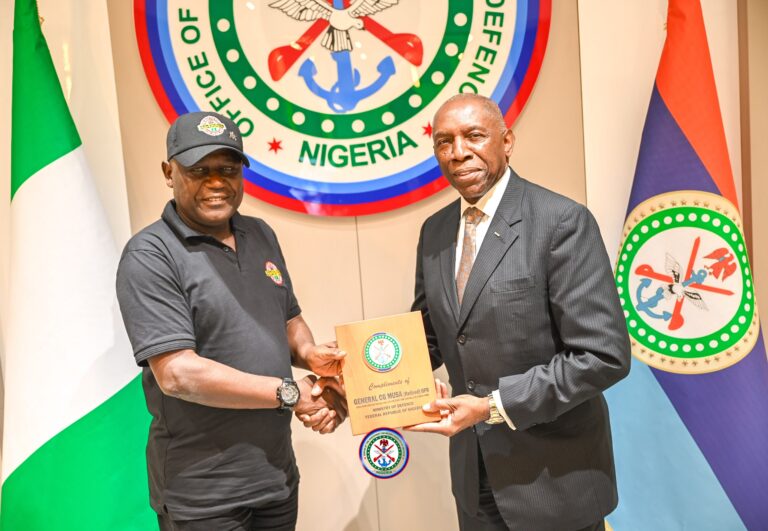
Nigeria has reaffirmed its commitment to strengthening defence cooperation with the United States following a meeting between the Ministry of Defence and retired United States Army General William E. Ward, the first Commander of the US Africa Command (AFRICOM).
The former AFRICOM chief paid a courtesy visit to the Ministry of Defence headquarters, Ship House, in Abuja, where he was received on behalf of the Minister of Defence, General Christopher Gwabin Musa (Rtd), by the Permanent Secretary, Richard Pheelangwah.
Delivering the Minister’s message, Pheelangwah welcomed General Ward and praised his contribution to security cooperation across Africa during his time as AFRICOM’s inaugural commander.
He said Nigeria remains committed to expanding its defence partnership with the United States through military training, intelligence sharing, counter-terrorism operations, maritime security, logistics and professional military education.
The Permanent Secretary also stressed the need for greater investment in innovation, emerging technologies and capacity building to help security agencies respond to modern threats.
Both sides described the meeting as another step in the long-standing relationship between Nigeria and the United States, noting that continued cooperation would strengthen regional and global security.
Discussions also focused on lessons for African armed forces, stronger strategic partnerships, artificial intelligence in defence planning, cybersecurity and preparing future military leaders for increasingly complex security challenges.
In his remarks, General Ward praised Defence Minister Christopher Musa for his leadership, both as Nigeria’s Chief of Defence Staff and now as Minister of Defence.
He also called for deeper economic cooperation between Nigeria and the United States, while stressing the need to tackle security challenges through stronger partnerships.
Ward further highlighted the growing importance of cybersecurity and strong family values, saying both remain essential pillars for building resilient societies and effective national security.