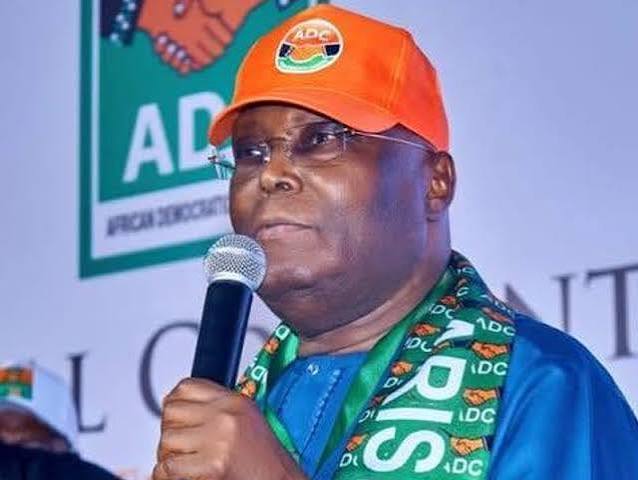
Former Vice President and African Democratic Congress (ADC) presidential candidate, Atiku Abubakar, has accused President Bola Tinubu’s administration of making it increasingly difficult for ordinary Nigerians to afford a decent life.
Atiku was reacting to the latest Central Bank of Nigeria (CBN) Household Expectations Survey, which showed a sharp decline in Nigerians’ willingness to buy major household items, including cars, homes and other durable goods.
He described the figures as a damning assessment of the government’s economic policies.
In a statement issued by his Senior Special Assistant on Public Communication, Phrank Shaibu, Atiku said an economy where families can no longer consider buying homes, cars or basic household assets cannot reasonably be described as an economy delivering prosperity.
The CBN survey placed buying conditions at 28.7 points for motor vehicles, 28.9 points for consumer durables and 30 points for buildings and landed property.
Willingness to buy was even lower. It stood at 18.7 points for vehicles and just 19.2 points for buildings and landed property.
Atiku said the figures were not opposition propaganda but reflected the views of Nigerian households captured by the CBN itself.
According to him, the message from the figures is clear: Nigerians are struggling to afford the things that once represented basic progress.
“A home is becoming a fantasy. A car is becoming a luxury. Household appliances are increasingly beyond reach,” he said.
Atiku argued that families are spending most of their income on food, transport, electricity, school fees and other necessities, leaving little or nothing for savings, investment or asset ownership.
He also pointed to the latest SBM Jollof Index, which estimated that the ingredients needed to prepare a pot of jollof rice for a family of five now cost about ₦29,578.
For someone earning the ₦70,000 minimum wage, Atiku noted, that single meal would consume more than 40 per cent of a monthly salary.
That is before rent, transport, electricity, school fees and healthcare are taken into account.
Atiku said the situation showed that the economic crisis was no longer just about statistics but about what Nigerian families can actually afford.
He accused the Tinubu administration of celebrating macroeconomic indicators such as GDP growth and foreign reserves while many households continue to struggle with the rising cost of everyday life.
“Government officials can celebrate GDP growth, foreign reserves and other statistics from air-conditioned conference rooms, but ordinary Nigerians have become unwilling economists,” he said.
According to him, Nigerians now have to calculate the cost of every meal, litre of fuel and transport fare before deciding what they can afford.
“Between official statistics and empty cooking pots, the cooking pots do not lie,” he said.
Atiku also warned that falling household purchasing power could hurt businesses and the wider economy.
He argued that when people cannot afford to buy goods and services, businesses struggle to sell, production slows and jobs are eventually affected.
He said economic success should not be measured only by figures quoted by government officials, but by whether ordinary people can work, earn, eat, save and improve their standard of living.
“Before there is GDP, there must be dinner. Before there is prosperity, there must be purchasing power,” Atiku said.
He urged President Tinubu to focus more on the realities facing families rather than relying heavily on headline economic figures.
“The real economy is the Nigerian family’s pocket, and that pocket is increasingly empty,” he said.
Atiku concluded that Nigerians deserved an economy where hard work could provide dignity and opportunity, rather than one where families were forced to sacrifice their ambitions simply to survive.
“Tinubu has not merely increased the cost of living. He has increased the cost of dreaming,” he said.