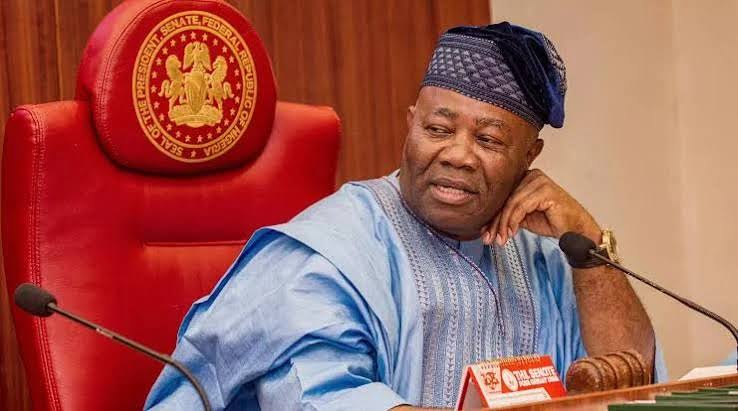
Senate President Godswill Akpabio has challenged former Rivers State Governor, Rotimi Amaechi, to provide documentary evidence to support his allegation that 50 per cent of payments to contractors handling Niger Delta Development Commission (NDDC) projects were being deducted.
Akpabio described the allegation as serious, insisting that Amaechi had yet to present contract documents, payment records or details of specific transactions to back his claims.
The Senate President’s position was contained in a statement issued in Abuja by his Special Adviser on Media and Publicity, Eseme Eyiboh.
Amaechi, a former Minister of Transportation and African Democratic Congress (ADC) chieftain, made the allegation while addressing supporters at the party’s campaign rally at Tafawa Balewa Stadium in Bauchi State on Saturday.
He also criticised President Bola Tinubu over the country’s economic difficulties.
The former governor’s accusation reportedly followed comments Akpabio had made about him in Port Harcourt.
Reacting, Akpabio challenged Amaechi to identify the contractors affected, the projects involved, when the alleged deductions took place and the payment arrangements through which they were made.
He also demanded evidence linking him personally to the alleged practice.
“An allegation delivered before an enthusiastic political audience does not, by that circumstance alone, acquire the status of a fact,” Akpabio said.
He urged Amaechi to submit any credible evidence to the appropriate investigative authorities rather than turn the matter into a political confrontation.
“If Amaechi possesses credible evidence of unlawful deductions involving NDDC contractors, the appropriate course is to identify the relevant transactions, disclose the supporting records and submit the material to competent investigative authorities and not the act of rabble-rousing,” he added.
The Senate President also turned attention to Amaechi’s eight-year administration as Rivers State governor between 2007 and 2015, arguing that his own record in office should be open to public scrutiny.
He specifically mentioned the Port Harcourt monorail project, which attracted controversy over its reported cost, incomplete implementation and failure to deliver the expected public transport service.
Akpabio also raised questions about the Malaria-Free Rivers State initiative, calling for accountability over public spending, project delivery and value for money.
He argued that public officials should be prepared to explain how much was spent on projects, what they achieved and the decisions that influenced their outcomes.
“Public accountability does not begin and end with one’s political opponents. It extends to every public official entrusted with resources, authority and responsibility,” he said.
With the 2027 general elections approaching, Akpabio warned against using political campaigns to promote allegations that had not been backed by evidence.
He stressed that the NDDC’s finances and operations deserved proper scrutiny, given the commission’s responsibility to address infrastructure and environmental challenges in the oil-producing Niger Delta.
Akpabio maintained that the interests of the region’s people should remain central to discussions about the commission, particularly in areas of transparent procurement, completed projects and measurable development.
He added that while Amaechi had every right to raise concerns about public administration, he also had a responsibility to distinguish between allegations and claims supported by verifiable evidence.
“The credibility of a public allegation must rest not on the volume of its delivery, the status of its author or the occasion on which it is made, but on the quality of the evidence supporting it. Let the facts speak,” he said.