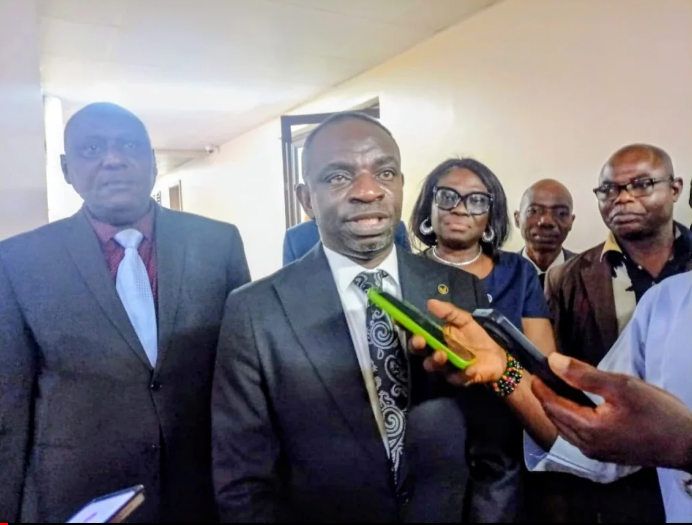
Tension is mounting at the Police Service Commission (PSC) as workers threaten an indefinite strike over unpaid allowances dating back several years.
The outstanding payments include allowances for the 2022 Ekiti and Osun governorship elections, the 2023 general elections, official trips and other assignments carried out on behalf of the commission.
The workers are also demanding payments for the Police Academy, the 2016 police recruitment exercise, the Departmental Selection Board and outstanding balances for the 2025 Police Constable medical screening.
Other unpaid entitlements include the balance of the first 28 days’ payment owed to some members of staff.
Some workers, who spoke to The PUNCH on Sunday on condition of anonymity, expressed frustration over what they described as years of neglect, saying some colleagues had borrowed money to carry out official assignments without receiving reimbursement.
One of the workers said the commission had yet to pay allowances for the 2023 general elections and the 2022 Ekiti and Osun elections, despite preparations for another round of elections.
The worker said some staff had even borrowed money to finance election-related assignments, but management had failed to settle the bills.
Another employee complained about the poor condition of some offices, particularly those in Wing B of the commission’s building, saying the working environment was not conducive.
The official called on management to provide adequate facilities, including air-conditioning systems, to protect workers from excessive heat and improve productivity.
In a letter dated November 10, the unions issued a seven-day ultimatum, threatening to embark on an indefinite strike if the outstanding payments were not settled.
“This letter serves as a notice of industrial action with a seven-day ultimatum, after which we will proceed with an indefinite industrial action,” the unions stated.
The warning followed a meeting of the Joint Union Congress (PSC Unit) held on November 2 at the commission’s headquarters in Jabi, Abuja.
A communiqué issued after the meeting on November 5 was signed by leaders of the commission’s units of the Association of Senior Civil Servants of Nigeria and the Nigeria Civil Service Union.
The unions alleged that the commission’s former management had secured an intervention fund from the Federal Government to settle outstanding staff liabilities, but accused the current leadership of failing to pay the workers.
They expressed frustration over what they described as repeated delays despite several letters and meetings with management.
The unions insisted that all outstanding staff entitlements should be paid immediately, arguing that a change in leadership should not erase liabilities inherited from previous administrations.
“Leadership is a continuum, and so, no management can run away from liabilities owed to staff, just as they enjoy the assets inherited,” the November 10 letter stated.
The unions further alleged that some workers had resorted to borrowing from loan sharks to finance official assignments, while others had died with outstanding debts.
Beyond the unpaid allowances, the workers raised concerns about alleged favouritism in staff training opportunities, failure to implement revised Duty Tour Allowance rates and non-payment of welfare packages.
They also complained about inadequate staff buses, saying some of the vehicles were repeatedly repaired but continued to break down, leaving employees stranded.
The unions called for an increase in allowances paid to National Youth Service Corps members attached to the commission, describing the current rates as inadequate.
They also accused management of sidelining the Public Service Rules, excluding directors and heads of departments from key decisions and failing to provide adequate financial information.
The November 10 letter further questioned the commission’s purchase of 2026-model vehicles while workers remained unpaid and staff transportation was still inadequate.
The unions also expressed concern over what they suspected was the possible availability of an intervention fund, despite management’s position that staff should await fresh funding.
In the November 5 communiqué, however, the unions said they remained committed to constructive engagement and industrial harmony, warning that workers’ welfare could no longer be ignored.
Reacting, the PSC spokesman, Torty Kalu, said the intervention fund intended to clear the outstanding debts had not been released to the commission.
He also dismissed claims that money approved for settling the workers’ entitlements had been diverted to purchase vehicles.
Kalu explained that funds released for specific commission activities could not be diverted to settle outstanding liabilities without affecting ongoing assignments.
He said the board had appealed to workers to remain patient while efforts continued to secure the intervention fund.
According to him, the commission’s secretary had repeatedly visited the Accountant-General’s office to follow up on the release of the money.
Kalu maintained that management had no intention of abandoning its financial obligations to staff, insisting that the commission was working towards settling the outstanding payments.