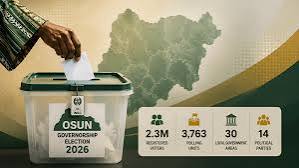
On 15 August, the people of Osun State will do more than elect a governor. They will make a statement about what matters to them as voters.
Will they reward performance? Will they examine the plans of the candidates? Will they ask who can create jobs, fix roads, improve schools, strengthen healthcare and make life a little easier?
Or will the election once again come down to party loyalty, political alliances, personality and the familiar Nigerian politics of “our man”?
That is the real question hanging over Osun.
The campaign has been intense, with incumbent Governor Ademola Adeleke seeking another term and the APC’s Bola Oyebamiji and ADC’s Najeem Salaam among the leading challengers. The contest has also attracted wider political attention because of what it could mean beyond Osun, particularly as Nigeria gradually moves towards the 2027 political season.
But somewhere in all the noise, the voter risks getting lost.
Politics has become personal
Nigerian elections are rarely just about policies anymore.
They are about who knows who. Who belongs to which party. Who has the backing of a political heavyweight. Who can mobilise the crowd. Who has the money. Who has the structure.
And, increasingly, who can tell the most convincing story about the opponent.
This is where the Osun election should be different.
A governorship election should not be a popularity contest. It should be a job interview.
The candidates are applying to manage the resources, institutions and future of an entire state. The voters are the employers.
And employers should ask questions.
What will you do about unemployment?
How will you improve education?
What is your plan for healthcare?
How will you attract investment?
What will you do about roads and rural development?
How will you increase internally generated revenue without squeezing an already struggling population?
What is your plan for young people who are increasingly looking outside Nigeria for opportunities?
These are not glamorous campaign questions. They do not always produce the loudest applause at rallies.
But they are the questions that matter.
The danger of voting for ‘our person’
There is nothing wrong with having political loyalty. Parties exist for a reason, and people are entitled to support candidates whose values or political beliefs they share.
The problem begins when loyalty becomes blind.
A voter should be able to say: I support this candidate, but I will still question him.
That is democracy.
Unfortunately, Nigerian politics often works differently. Once a politician becomes “our person”, every criticism becomes an attack. Every failure is excused. Every opponent is treated as an enemy.
That mindset is dangerous.
A governor does not govern only the people who voted for him. He governs everyone.
The road built in an opposition community is still a road for everyone. The hospital improved by one administration can save the life of someone who voted against it. A job created does not ask for a voter’s party card.
Development has no political party.
But performance must also be measured honestly
There is another side to this conversation.
It would be unfair to tell voters to ignore what an incumbent has achieved simply because elections should be about the future.
If a government has performed, it deserves credit.
If it has failed, voters have every right to demand an explanation.
The important thing is evidence.
Not social media propaganda. Not campaign posters. Not praise singers.
Evidence.
What was promised? What was delivered? What changed? What remains unfinished? What did it cost? And what can reasonably be achieved in another term?
These questions should apply to every candidate, not just the one we dislike.
Opposition parties also have homework
It is easy for opposition candidates to say, “The government has failed.”
But Nigerians should ask the next question: What will you do differently?
Criticism without a credible alternative is not a manifesto.
Osun voters deserve more than promises to “rescue” the state. They deserve details.
If a candidate says he will create jobs, how?
If he promises better infrastructure, where will the money come from?
If he says he will reduce poverty, what exactly is the strategy?
If the answer to every problem is simply “we will do better”, then Nigerians should politely ask: How?
Politics should be about solutions, not just slogans.
Osun must resist becoming another 2027 rehearsal
There is also a bigger danger.
Because Nigeria is already drifting towards 2027 politics, the Osun election could easily become a proxy battle between national political interests.
That would be a mistake.
Osun is not a chessboard for politicians looking to measure their strength before 2027.
It is a state with real people facing real problems.
A trader does not wake up worrying about which political alliance will dominate Abuja. He worries about sales.
A parent is more concerned about school fees than political permutations.
A young graduate wants a job, not another political slogan.
A farmer wants a good road to the market.
A patient wants a functioning hospital.
That is the Osun that politicians should be talking about.
The voter has the final word
The beauty of an election is that politicians can make promises, hire campaign teams, print posters and fill stadiums.
But ultimately, the voter has the power.
That power should be used wisely.
Osun voters should not be bullied into choosing a candidate because of party loyalty. They should not be bribed into surrendering their future for a bag of rice or a few thousand naira. And they should not allow ethnic, religious or political sentiment to replace judgement.
Vote for the person you believe can do the job.
If that happens to be your party’s candidate, fine.
If it is not, democracy gives you the freedom to choose.
The real winner on 15 August should not simply be Adeleke, Oyebamiji, Salaam or any other candidate.
The real winner should be Osun.
And perhaps the most important question voters can ask before entering the polling booth is a very simple one:
“If I remove the party logo, the political godfathers and the campaign noise, which candidate do I honestly believe can make my life and my community better?”
That is the candidate worth voting for.
Not necessarily the loudest.
Not necessarily the most popular.
Not necessarily the candidate backed by the biggest political machine.
The one who can deliver.