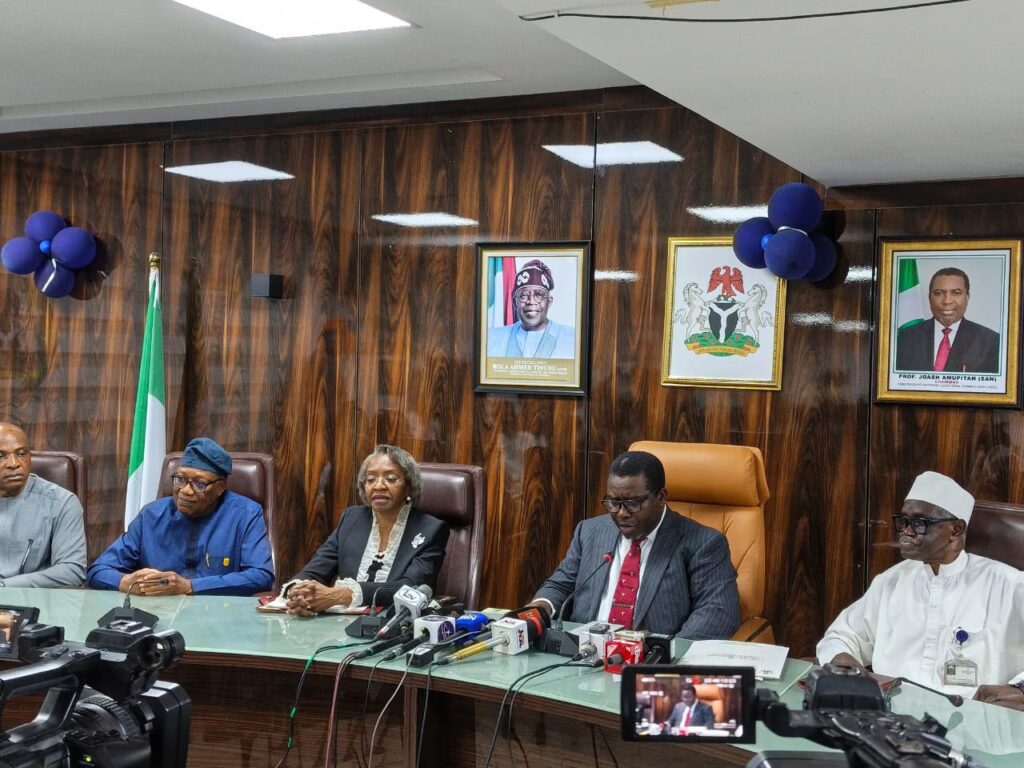
The Independent National Electoral Commission (INEC) has commenced investigations into 54 registration officials across 10 states over alleged irregularities in the voter registration process.
The commission also announced that it had removed 1,609,553 invalid records from the national voter register as part of efforts to strengthen its credibility ahead of the 2027 general elections.
INEC Chairman, Professor Joash Ojo Amupitan, disclosed this on Monday in Abuja while presenting the outcome of the review of the Preliminary Register of Voters.
He said the investigation followed complaints and objections submitted by Nigerians during the public display of the preliminary register at ward levels between October 9 and 15, 2026.
The 14-day review period exposed several suspected irregularities, including multiple registrations, altered photographs, suspicious registration patterns and entries belonging to deceased persons.
Amupitan explained that the commission subjected questionable records to biometric checks and further verification before deciding which should be retained or removed.
INEC explains how 1.6 million records were removed
According to the chairman, INEC received 11,088,238 registration records from the three phases of the 2025/2026 Continuous Voter Registration exercise.
The commission’s Automated Biometric Identification System initially flagged 1,545,052 records for further examination.
However, Amupitan stressed that being flagged by the automated system did not automatically mean a registration was invalid. Each questionable entry had to undergo additional checks.
Following the verification process, 1,277,052 registrations were confirmed as invalid and removed before the publication of the Preliminary Register.
A further review after the public display examined 268,000 cases. Of these, 217,722 were invalidated, while 50,278 were cleared and retained.
Another screening exercise identified 113,886 additional invalid registrations.
Amupitan said the overall review also led to the removal of 331,608 invalid records following claims and objections, alongside 873 independently verified records belonging to deceased voters.
When combined with the 1,277,052 records previously removed, the total number of invalid registrations expunged stood at 1,609,553.
54 officials face possible prosecution
Beyond cleaning up the voter register, INEC said its investigations had uncovered possible violations of registration procedures by some officials.
Amupitan alleged that certain personnel manipulated the registration process, including abusing provisions designed to assist persons with disabilities and people facing exceptional circumstances.
He said 54 officials across 10 states had been identified in connection with the alleged misconduct.
“Fifty-four persons cutting across ten states have been identified as complicit and necessary disciplinary action will be taken against them, including possible prosecution,” he said.
The chairman also acknowledged that the national voter register had longstanding integrity challenges dating back to registration exercises conducted between 2011 and 2023.
He explained that some questionable names and photographs circulating on social media were inherited from previous registration exercises and were not necessarily linked to the latest registration process.
Consequently, INEC resolved at its November 9 meeting to extend its verification exercise to older records, including previously flagged entries and cases involving obvious irregularities.
INEC explains why some voters cannot find their names
The commission also addressed complaints from Nigerians who could not find their names at their current places of residence.
Amupitan attributed many of these cases to the failure of voters to complete the formal transfer of their registration after relocating.
He explained that some people who moved to new areas registered afresh instead of transferring their existing voter records.
Such new registrations were subsequently flagged and invalidated by the biometric system, leaving the original records at their former polling units.
He advised affected voters to check their previous registration locations to confirm whether their details were still on the register.
On Permanent Voter Card (PVC) distribution, the INEC chairman said collection of cards from the first and second phases of registration, including transferred PVCs, was continuing at local government offices nationwide.
He added that cards produced during the third phase were being delivered and would be dispatched to states the following week.
Distribution was expected to return to Registration Areas across the country from December 1, 2026.
INEC strengthens safeguards ahead of 2027 elections
Amupitan assured Nigerians that the commission was strengthening its safeguards against multiple accreditation and voting ahead of the 2027 elections.
He said the Bimodal Voter Accreditation System (BVAS), alongside INEC’s operational guidelines, requires voters to undergo biometric authentication at their designated polling units using fingerprints or facial recognition.
The chairman also recalled that INEC had earlier announced plans for a nationwide voter revalidation exercise in February 2026 to address historical inconsistencies in the register.
However, the exercise was postponed until after the 2027 general elections following concerns from stakeholders that carrying it out so close to the polls could affect voter participation.
He maintained that the postponement had not stopped the commission from conducting routine checks and other measures to protect the integrity of the register.
INEC said it remained committed to removing invalid records without disenfranchising eligible voters.
The commission is expected to publish the Final Register of Voters on December 15, 2026, after completing its reconciliation and quality assurance processes.